

Health Benefits
This rye sourdough bread combines the nutritional advantages of rye with the benefits of natural fermentation. Rye is naturally rich in fiber and tends to promote greater satiety than many refined breads, helping meals feel more satisfying. The fermentation process contributes to flavor development while also supporting the availability of certain minerals found in the grains.
Walnuts bring healthy unsaturated fats, fiber and plant compounds that complement the grain-based foundation of the bread. Together, the ingredients create a loaf that provides both nourishment and flavor while fitting naturally into a balanced way of eating.
Plant count: 3 🌱


A Closer Look at Key Ingredients
- Provides natural fermentation
- Enhances flavor complexity
- Supports traditional bread-making methods
- Contributes organic acids formed during fermentation
- Rich in plant-based omega-3 fatty acids
- Contain antioxidants that support cardiovascular health
- Contribute fiber and healthy fats for longer fullness
- Provides fiber that supports digestive health
- Helps promote long-lasting satiety
- Contains minerals including magnesium and phosphorus
- Traditionally used in many fermented breads
- Provides structure and elasticity
- Helps create a lighter crumb
- Works together with rye for balanced texture
- Contributes carbohydrates for energy
Some of the best things in the kitchen simply need time.
Anonymous
Pro Tips
- Shape the dough gently to preserve the air created during fermentation.
- Lightly toast the walnuts before mixing them into the dough if you want a deeper nutty flavor.
- Allow the loaf to cool completely before slicing to help the crumb finish setting.
- A Dutch oven or cast-iron pot helps create the crisp crust many sourdough bakers enjoy.
- Fresh bread is wonderful, but the flavor often becomes even better the following day.

Did You Know?
Rye is one of the higher-fiber cereal grains, and this fiber is one reason rye breads often feel more filling than many refined wheat breads. In a 12-week randomized intervention, high-fiber rye foods influenced gut microbiota composition and were linked with higher plasma butyrate, a short-chain fatty acid produced when gut bacteria ferment fiber.
Sourdough fermentation adds another layer. During the long resting time, wild yeasts and lactic acid bacteria produce organic acids that shape flavor, texture and digestibility. This is why rye sourdough can feel so satisfying: it combines naturally fiber-rich grain with slow fermentation and, in this recipe, walnuts for extra healthy fats and texture.
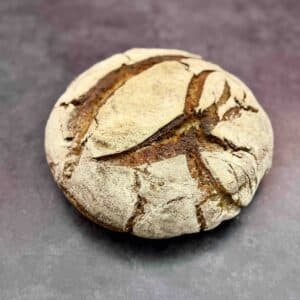
Rye Sourdough Bread with Walnuts
Ingredients
- 295 g rye flour
- 300 g wheat flour
- 390 g water
- 13 g salt
- 7 g active rye sourdough starter
(Learn how to make and maintain a starter in our Complete Sourdough Starter & Fermentation Guide). - 80-100g walnuts roughly chopped
Instructions
- In a large bowl, combine the rye flour, wheat flour, water, salt, rye sourdough starter, and walnuts. Mix until no dry flour remains.
- Cover the bowl and let the dough rest at room temperature for 24 hours. During the first 12 hours, gently stretch and fold the dough once or twice if desired.
- After about 12 hours, transfer the dough to a lightly floured surface and gently shape it into a round loaf.
- Place the shaped dough into a floured proofing basket or bowl lined with a clean kitchen towel.
- Let the dough rest for another hour at room temperature.
- About 30 minutes before baking, preheat the oven and a Dutch oven or heavy baking pot to 250°C (480°F).
- Carefully transfer the dough into the hot pot, cover with the lid, and bake for 30 minutes.
- Remove the lid, reduce the temperature to 230°C (445°F), and bake for another 15–18 minutes until deeply golden and crisp.
- Transfer the bread to a wire rack and allow it to cool completely before slicing.